Soybean Oil Yield Improvement: Desolventizer Optimization to Cut Solvent Residue and Boost Crude Oil Purity
2026-02-25
QI ' E Group
Application Tutorial
This tutorial-style article explains how soybean oil plants equipped with desolventizing systems can significantly increase extraction yield while improving crude oil purity and soybean meal quality through targeted equipment upgrades and process optimization. It clarifies the complementary roles of mechanical pressing and solvent extraction, with a practical focus on the desolventizer’s function in reducing residual solvent and ensuring meal safety and stability. Key operating levers are reviewed across cleaning, conditioning, dehulling, and desolventizing—showing how parameter tuning (e.g., moisture/temperature control, hull removal efficiency, residence time, and steam management) can raise oil recovery, lower solvent carryover, and enhance downstream consistency. Supported by real-world plant examples and actionable maintenance guidance, the article provides decision-ready insights for technical managers and equipment buyers aiming to improve throughput and product competitiveness. Readers are invited to download a complete operating parameter handbook and book an expert remote diagnostic session to accelerate on-site implementation.
Why Soybean Oil Yield Stalls—and Why Desolventizing Is Often the Hidden Bottleneck
In solvent extraction plants, yield improvements rarely come from a single “magic” setting. They come from tightening control across preparation, extraction, and—most often underestimated—the desolventizing system. When desolventizing-toasting (DT) is not optimized, plants typically see higher residual hexane in meal, avoidable oil losses in miscella handling, unstable crude oil quality, and inconsistent meal functionality—each of which quietly erodes extraction rate and product value.
Core takeaway (operations-friendly):
A well-tuned desolventizing section helps keep meal residual solvent low (often ≤ 300 ppm in many modern lines), stabilizes crude oil moisture & volatile content, and protects overall oil recovery—especially when upstream preparation is already “good enough.”
Mechanical Pressing vs. Solvent Extraction: The Practical Synergy (Not a Rivalry)
Modern soybean oil processing typically uses pre-pressing + solvent extraction or direct solvent extraction depending on capacity, energy strategy, and desired meal specs. Mechanical pressing reduces extractor load and may simplify miscella handling, while solvent extraction drives the last increments of oil recovery.
Reference ranges used by many plants (for benchmarking)
Note: Targets vary by national regulations and customer specs. Use these as internal diagnostic signposts, not a universal promise.
Where Yield Is Won: Preparation Parameters That Make DT Easier (and Oil Recovery Higher)
Desolventizing performance is strongly influenced by what enters the DT: pore structure, solvent distribution, fines level, and moisture profile. If the flakes and extracted meal are inconsistent, DT must compensate with more steam and residence time—often at the cost of meal quality and energy.
Effective cleaning reduces metal wear, stabilizes cracking/conditioning, and improves extractor hydraulics. Many plants see more stable operation when foreign matter is held below 0.5% of incoming beans. A cleaner feed reduces fines generation, which otherwise can increase bed resistance and create solvent maldistribution—both linked to higher retained oil in spent meal.
Operator cue:
If extractor differential pressure rises while throughput is unchanged, check cleaning screens, aspiration efficiency, and fines build-up before adjusting solvent ratio.
2) Conditioning & flaking: build permeability without overcooking the protein
Conditioning aims for a temperature and moisture window that supports efficient cell rupture and diffusion while keeping meal specs in range. In practice, many soybean lines condition in the neighborhood of 60–75°C prior to flaking, then manage final flake thickness often around 0.25–0.35 mm (plant-dependent). Over-thin flakes can increase fines and collapse the bed; over-thick flakes can slow leaching and raise residual oil.
A repeatable flake profile is one of the fastest ways to improve extraction consistency and reduce DT steam demand because solvent is more evenly distributed and easier to strip.
3) Dehulling: less fiber, better extraction kinetics (when controlled)
Proper dehulling typically reduces fiber load and can improve both oil recovery and meal value. However, aggressive dehulling that creates excess fines may backfire by reducing percolation efficiency in the extractor and increasing entrainment in miscella. Many plants treat hull fraction and particle size distribution as a system KPI, not a single equipment KPI.
DT / Desolventizing Optimization: How to Cut Residual Solvent Without Sacrificing Meal Quality
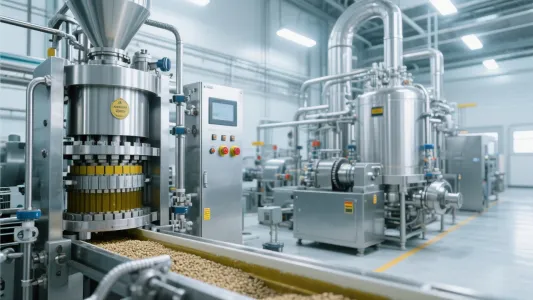
The DT system is a mass-transfer and heat-transfer problem under production constraints. The goal is to remove hexane efficiently while hitting meal moisture, toasting, and cooling targets. Plants that only “turn up steam” often achieve lower residual solvent temporarily, but end up with overdried meal, reduced PDI/NSI, higher energy consumption, and unstable deodorization behavior downstream.
Focus area A: Steam strategy (direct vs. indirect)
Direct steam supports stripping and moisture adjustment; indirect heating supports controlled temperature lift. Many stable lines control meal discharge moisture around 11–13% (application-dependent) to preserve handling and meal quality while ensuring solvent removal. A practical approach is to confirm steam quality (dryness fraction), valve response, and distribution uniformity before changing setpoints.
Focus area B: Residence time & bed depth stability
Solvent removal is sensitive to residence time distribution. If feed surges or level controls are unstable, “short-circuiting” can occur, leaving pockets of meal with higher solvent. Plants often reduce variability by tightening upstream feed control and maintaining consistent bed depth across trays rather than simply extending total residence time.
Focus area C: Vapor recovery & leak management
Air ingress, worn seals, and imperfect condensers increase solvent losses and reduce stripping efficiency. A plant-level hexane loss KPI is commonly tracked around 0.2–0.4 kg hexane per ton of beans for well-managed operations (varies by design). If losses rise, check for vacuum stability, condenser fouling, and gasket integrity before recalibrating process recipes.
Crude Oil Purity: Reducing “Invisible” Contamination from Miscella to Storage
Higher extraction rate is only valuable if crude oil quality remains stable. Elevated moisture, excessive fines, or entrained solvent can trigger foaming, increase degumming chemical demand, and stress centrifuges and filters.
Practical controls that usually move the needle
Miscella clarity: optimize screens/filters and prevent excessive fines generation upstream.
Evaporation stability: avoid temperature overshoot that can darken oil or increase non-hydratable gums formation risk.
Tank management: reduce water ingress and manage settling time; many plants target lower insoluble impurities to reduce downstream load.
Typical crude soybean oil moisture is often managed around 0.10–0.20% before further refining steps, depending on the refinery setup and customer requirements.
A Real-World Optimization Pattern: What Plants Often Change First (and What They Measure)
In many upgrades, the best results come from sequencing improvements instead of changing everything at once. A common plant pattern is to stabilize material preparation, then align extraction hydraulics, and only then tighten DT steam/vapor recovery control.
Example KPI shift observed in multiple optimization projects (illustrative)
KPI
Before tuning
After tuning
Operational impact
Residual hexane in meal
600–1200 ppm
200–350 ppm
Lower compliance risk, improved buyer confidence
Hexane loss (plant-wide)
0.6–0.9 kg/ton beans
0.25–0.45 kg/ton beans
Lower solvent make-up, better process stability
Spent meal residual oil
1.2–1.6%
0.8–1.1%
Higher oil recovery without pushing extractor harder
Crude oil insolubles
0.15–0.25%
0.08–0.15%
Reduced filter load, more stable refining behavior
These ranges reflect commonly reported outcomes when controls, sealing, and steam distribution are improved. Actual results depend on equipment design, bean quality, and baseline condition.
Maintenance & Daily Checks: The “Unsexy” Work That Keeps Yield High
Plants with consistently high soybean oil extraction rates treat DT and solvent recovery as reliability systems. Small degradations—fouled condensers, worn rotary valves, leaking manways—compound into lost solvent, unstable meal moisture, and erratic operation that operators compensate for with steam and throughput cuts.
Daily / weekly checklist that pays back fast
Verify DT steam traps and condensate removal; poor drainage often mimics “insufficient heating.”
Check vapor line insulation and condenser approach temperatures to detect fouling early.
Inspect seals on feeders/rotary valves; air ingress reduces stripping efficiency and raises losses.
Trend meal residual solvent, meal moisture, and hexane loss together—single KPIs can mislead.
Want the Exact DT Tuning Targets for Your Line?
Get a practical, engineer-ready reference that covers steam distribution logic, residence time stabilization, vapor recovery checkpoints, and troubleshooting maps for residual solvent and crude oil purity—built for soybean solvent extraction plants with desolventizing equipment.











.jpg)